
On careers · Ambition
Do You Care Enough?
On ambition, perseverance, and knowing what deserves your life.
 Jack ChallisPhysicist · AI/ML consultant
November 20263 min read
I recently read Bob Henderson’s essay in Nautilus about leaving theoretical physics. He was a graduate student working with S. G. Rajeev, who cared about the work itself. Henderson eventually heard what Rajeev was too diplomatic to say: “You didn’t fail, Bob. You quit.”
That made me ask who finishes hard things and who doesn’t. Picture four graduate students in the same lab, all equally smart. Alice likes the long days of getting the experiment to work, and she wants the result badly enough to keep going when the measurement fails for the fourth month in a row. Bob loves the tinkering and doesn’t much care whether it ever becomes a thesis. Charlie wants the title and the faculty job, and dreads every day of the work that gets him there. Deborah is in the lab because graduate school was the next thing after college.
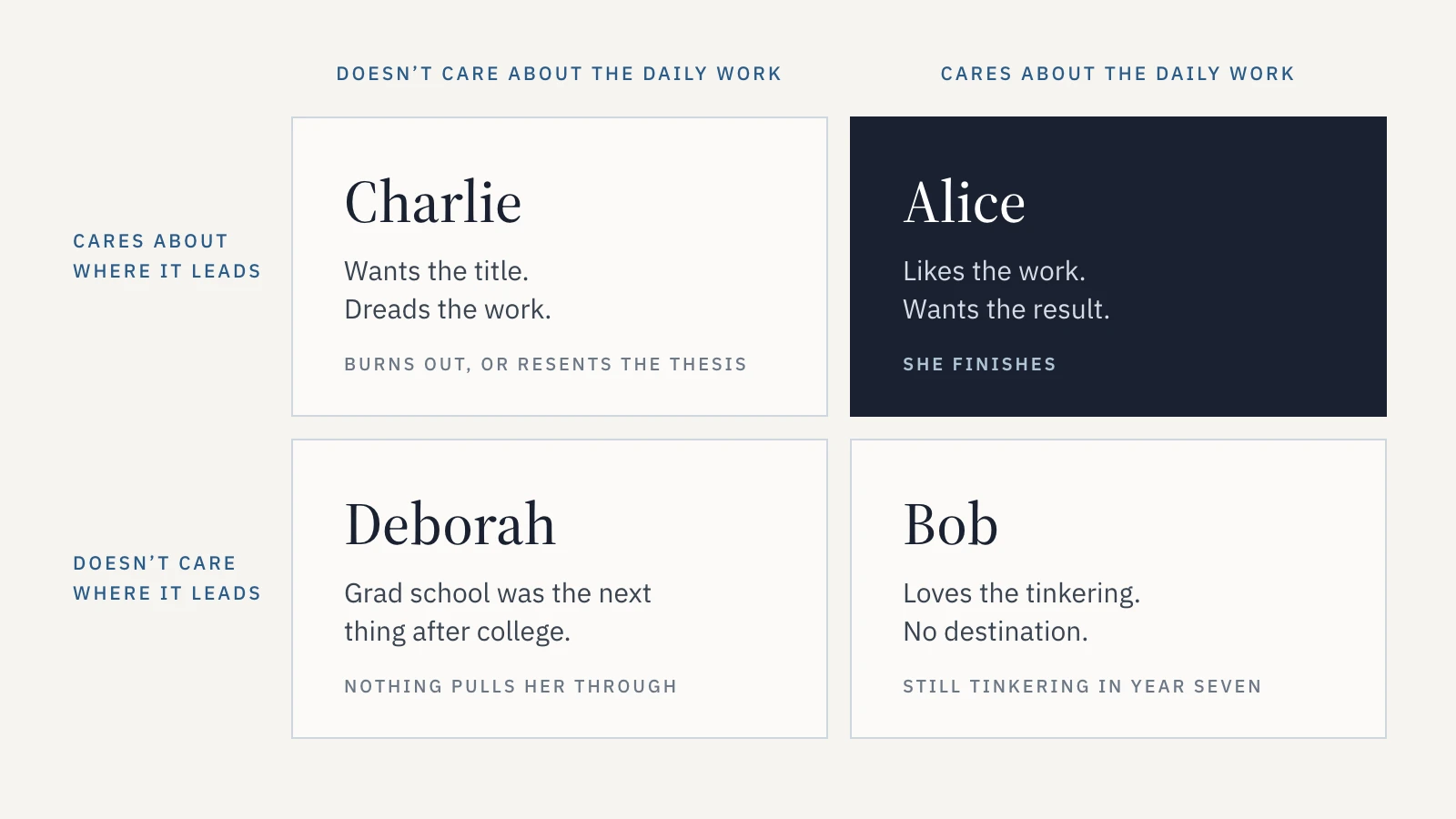
Two things have to be true at once: you care about the daily work, and you care about where it leads. Care only about the work and you end up like Bob, still improving the setup in year seven. Care only about the destination and you end up like Charlie, burned out or grinding out a thesis you resent. Care about neither and nothing pulls Deborah through. Only Alice finishes.
The uncomfortable part is how rare Alice’s box is. Most things you try won’t land there. That isn’t a failure of talent. Time and energy are finite, and there are far more worthwhile things than anyone can care about this deeply.

I can run this test on my own life. Why wasn’t my PhD more impactful? I didn’t care enough. Why could I never learn all the coding skill? I never cared enough. Why couldn’t I get really good at Go? I didn’t care enough. And where I have had success, I genuinely cared. I used to read those as verdicts on my ability. Now I read them as a record of where I was in the matrix.
01Try it, then decide what deserves your life
So try the work, early and cheaply. If you want to start a company, try selling something. If you want to be a mathematician, spend a month on problems you can’t solve. If you want to write a book, find out whether you like writing on the days nothing comes. Interest often grows with competence, so give it a fair trial. This is the advice behind Angela Duckworth’s Grit, Paul Graham’s “How to Do Great Work” and Kierkegaard’s Purity of Heart Is to Will One Thing. All of them assume you have already picked something that deserves the effort, and the picking is the hard part.
After the trial, ask two questions. Do I care about the daily work, and do I care where it leads? And what am I willing to stop doing to make room for it? If both answers are yes, commit completely.
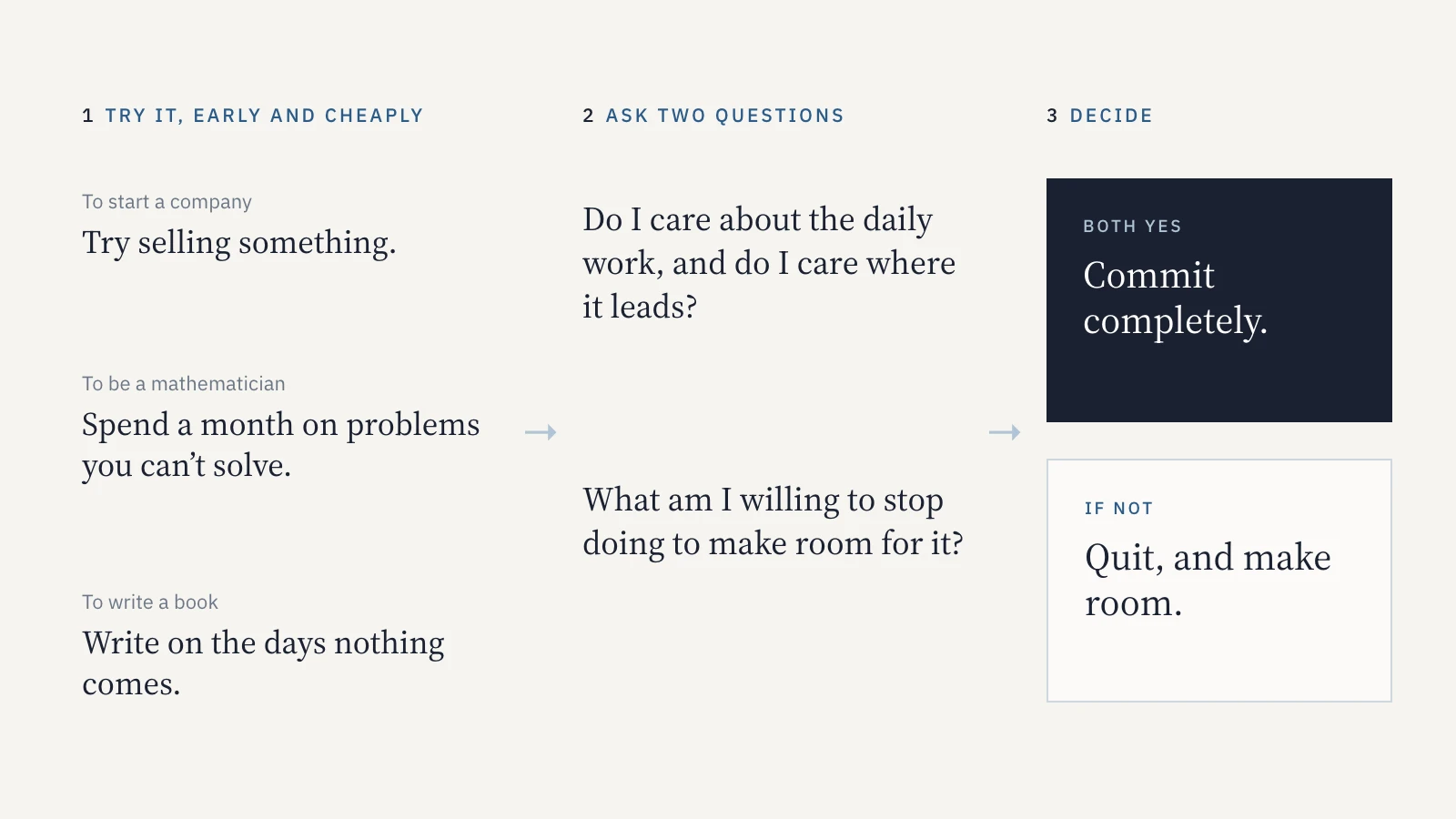
If the answer is no, it takes courage to quit, and it takes time, because quitting feels like the failure Henderson was told he’d chosen. I’d drop that label. Life is finite, and quitting the wrong thing is how you make room for the one where both are true.