
On careers · Advice
Through the Looking Glass
Career advice usually arrives as a smoothed biography. Step through the mirror instead, look hard at three terrible ideas, and see what they reflect back.
 Jack ChallisPhysicist · AI/ML consultant
September 20266 min read
Jack ChallisPhysicist · AI/ML consultant
September 20266 min read
When someone gives career advice, what you usually get is a smoothed biography, seen through rose-tinted glasses. Luck gets relabeled as skill. The rough pieces get sanded away. And every roll of the dice turns out to have been brilliant.

Mine doesn’t smooth well. I started at the University of Kentucky and did a physics PhD. Since then I’ve been a data scientist, an entrepreneur, a product manager, a biotech executive, an AI engineer, and now an AI consultant. From the inside, it never looked like a plan. And if I just tell you about my experience, I’m really only telling you about me. That isn’t much use to someone who is twenty, facing a different job market with different constraints.
So I tried something else. In Lewis Carroll’s Through the Looking-Glass, the sequel to Alice in Wonderland, Alice climbs through the mirror over the fireplace into a world where everything is reversed. Writing runs backwards. To get somewhere, you have to walk away from it. Who knew great children’s literature could come from a parity flip?
Instead of telling you what you should do, we can go through the glass and look at some ideas that are crazy and terrible. Then we come back and see what they reflect.
The best example I know is the silver rule. Most of us learned the golden rule: do unto others as you would have them do unto you. I actually find that pretty terrible advice, because it assumes you really understand what someone else wants, and that is genuinely hard. The silver rule is its reflection: don’t do unto others what you wouldn’t want done to you. It is much easier to follow.
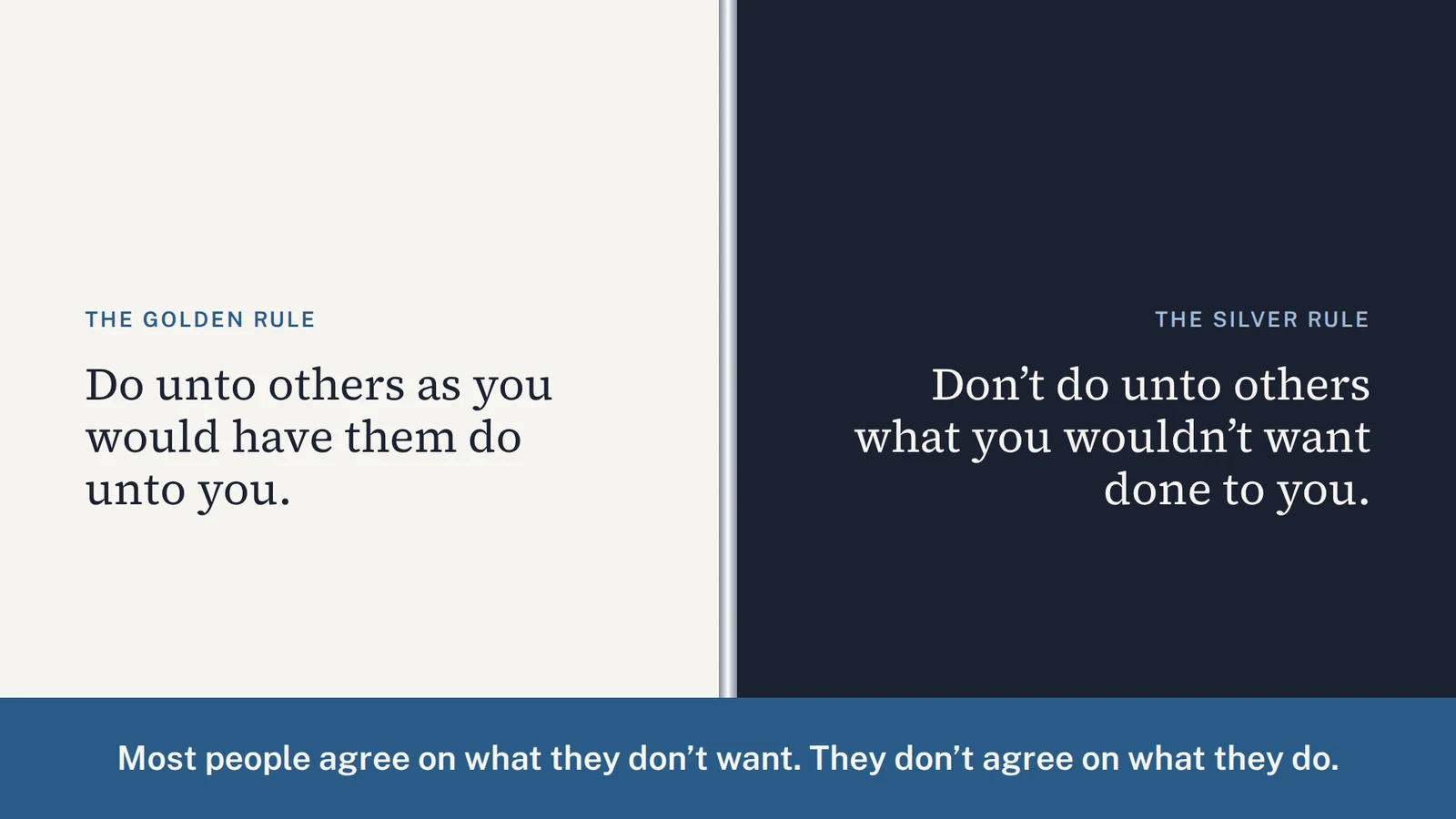
Most people agree on what they don’t want. They don’t agree on what they do.
That asymmetry works for careers too. I can’t tell you what a great career looks like for you. But I can walk you through three terrible ideas, and I suspect you’ll agree they’re terrible.
01Treat your environment as fixed
The first terrible idea: your environment doesn’t matter. Industry, geography, peers — none of it matters, as long as you do a good job.
School teaches this by accident. Same classroom, same exam, and the only variable is how you perform. Adult life is very much not like that. You get to choose the room.
Take two people who work equally hard. Put one in a growing industry and one in a shrinking one, and ten years later they’ll have very different opportunities. Put someone around people doing ambitious, interesting work, and their sense of what’s normal changes. Put them where the work in their field happens, and they hear about possibilities that never reach anyone else.
None of this means everyone should move to San Francisco and work in tech. I live out here, and I can give you a long list of reasons that might not be a good idea for you. Being near family has value. Building a life in Kentucky has value. The point is to know what you’re choosing, including what you’re giving up.
The same goes for first jobs. Look past the salary and ask what you’ll be able to do in two years that you can’t do now, and who you’ll learn it from. A good early job doesn’t just pay you. It changes the jobs you’re capable of doing next.
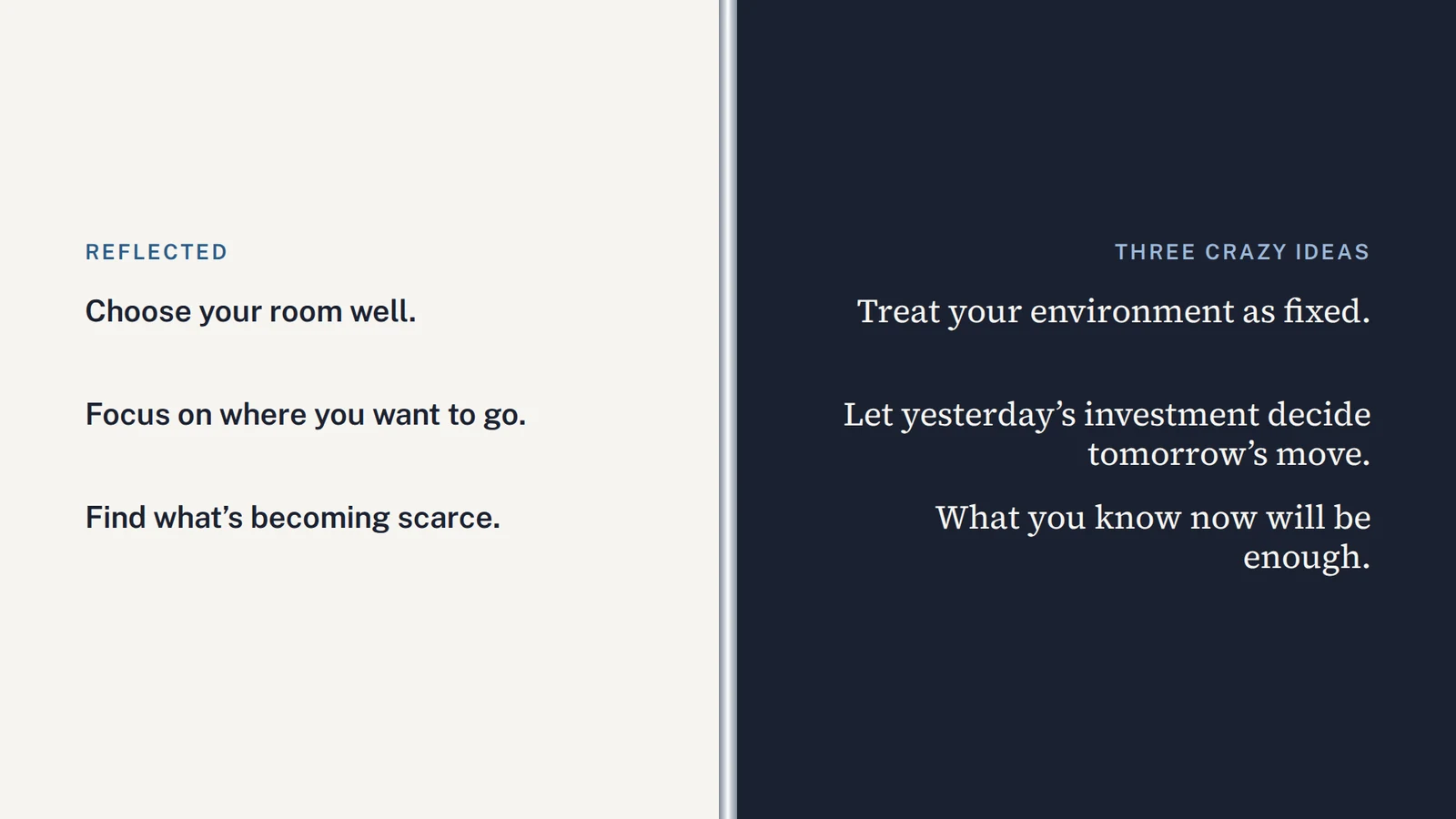
Reflected back: industry, geography, and peers are decisions, not scenery. Choose well.
02Let yesterday’s investment decide tomorrow’s move
The second terrible idea is the sunk cost fallacy with a career attached: let what you’ve already put in decide what you do next.
I know the name for it, and I make this mistake all the time. I’ve passed on opportunities because I was overinvested in what I’d been doing. I start calling myself a certain kind of person, a data scientist say, and data scientists do a certain kind of thing. So an opportunity comes up that would suit me well, and some part of me says: that’s not what a data scientist does.
For students, the version to watch is identity. It’s very easy to get wrapped up in one: I’m premed, I’m an engineer, I’m a physicist. That identity starts carrying a name tag, and then it gets very hard to switch. I did a physics PhD, and I use that training every day. I hope it isn’t the only thing I identify as. The training travels. The title doesn’t have to.
“I’ve already spent four years on this” is not the same sentence as “I should spend the next four years on this.”
Reflected back: focus on where you want to go, not where you’ve been. And be careful when identity starts closing opportunities instead of creating them.
03What you know now will be enough
Nobody says the third one out loud, but school is built as if it were true. You study for sixteen years, you graduate, and then you go use what you learned.
It’s been drummed into you pretty thoroughly that everything is changing, so I’ll skip the forecast. I build AI systems for a living, including ones that take over real work, and I still don’t know what the professions will look like in ten years.
What I can tell you is what happens when a new technology arrives: it makes something cheap. A job isn’t one task. It’s a bundle. When writing code gets cheap, deciding what to build, checking the results, and being responsible for what ships all matter more. When first-pass medical analysis gets cheap, knowing when it’s wrong and helping a patient through an ambiguous result matter more. Judgment, review, and accountability become the bottleneck, and the bottleneck keeps moving.
That isn’t painless. Some entry-level paths will get harder to get into, and hearing that human judgment still matters isn’t very comforting if no one will pay you to develop it. But rather than fighting the change, ask how it can put wind in your sails, so you can go where you want to go.
Reflected back: when something becomes cheap, identify what becomes scarce, and move with the bottleneck.
04What Alice brings back
So that’s my tour through the looking glass: three crazy ideas, and what each one reflects. If Alice came back through the mirror with one concrete, positive piece of career advice, I think it would be a single question. It’s the one I ask myself whenever I face a career choice:
Will this choice leave the future version of me with better options?
It works at twenty and it works at fifty, and it doesn’t require you to know yet what you want. That’s the best career advice I can give.
Adapted from a talk for University of Kentucky students, October 2026.